
Social Media: Your Hidden CRM!
When asked where their business comes from, most professionals give the same answer: "Sphere and referrals."
But there is a massive disconnect between that answer and daily behavior. Social media is already functioning as a CRM, yet most agents and lenders still treat it as a digital billboard or a passive distraction.
That is not a conceptual statement. It is observable behavior inside the platforms.
Every day, real estate agents, lenders, and marketing teams interact with the same systems they use to generate business. They scroll, react, comment, and occasionally post. What they are not doing at scale is intentionally capturing, organizing, and expanding relationships inside those same systems.
If referrals are your primary engine, the platforms where those relationships are built and sustained must be treated as core infrastructure—not an afterthought. It’s time to stop scrolling and start systematizing.
What the Data Actually Shows
Industry surveys consistently show that referrals and repeat clients account for the majority of closed transactions. That trend has remained stable across cycles. At the same time, platform usage data shows that real estate professionals are highly active on social channels, particularly Facebook, Instagram, and LinkedIn.
Two patterns emerge when those datasets are viewed together:
High reliance on referrals
High time investment in social platforms
However, there is a behavioral disconnect.
Platform analytics consistently show that:
A small percentage of connections receive direct engagement
The majority of activity is passive consumption
Connection growth is inconsistent and often unintentional
This creates a gap between where relationships originate and how they are managed.
A CRM is defined by its ability to:
Store relationships
Track interactions
Enable follow-up
Expand network value over time
Social platforms already perform each of these functions:
Profiles store identity and context
Activity feeds track interactions
Messaging enables follow-up
Networks expand through connections
The system is already in place. The behavior is not.
The Misalignment
Most professionals approach social media as a publishing environment. The assumption is that visibility leads to inbound opportunity.
That assumption stems from earlier platform behavior, in which organic reach and chronological feeds yielded predictable exposure. That environment no longer exists in the same way.
Current platform mechanics prioritize:
Relationship proximity
Interaction frequency
Network overlap
Engagement history
This is observable through feed composition. Users see more content from people they engage with and from second-degree connections connected to those interactions.
The result is simple:
Visibility is now a byproduct of relationships, not content volume.
If a professional is not actively building and strengthening connections, their content will have limited distribution, regardless of quality.
This is why many agents report consistent posting with limited business impact. The issue is not effort. It is the structure.
Social Media as a CRM System
When viewed through a CRM lens, social media behaves differently.
A traditional CRM requires manual input:
Adding contacts
Logging notes
Scheduling follow-ups
Social platforms automate much of this:
Connections are stored automatically
Interaction history is recorded in real time
Behavioral signals are visible without manual entry
Examples of CRM-like signals inside social platforms:
A past client comments on a post
A prospect views multiple stories
A connection changes life events or location
A referral source engages with shared content
Each of these actions would require manual tracking in a traditional CRM. On social platforms, they are visible in real time.
The limitation is not access to data. It is the intentional use of that data.
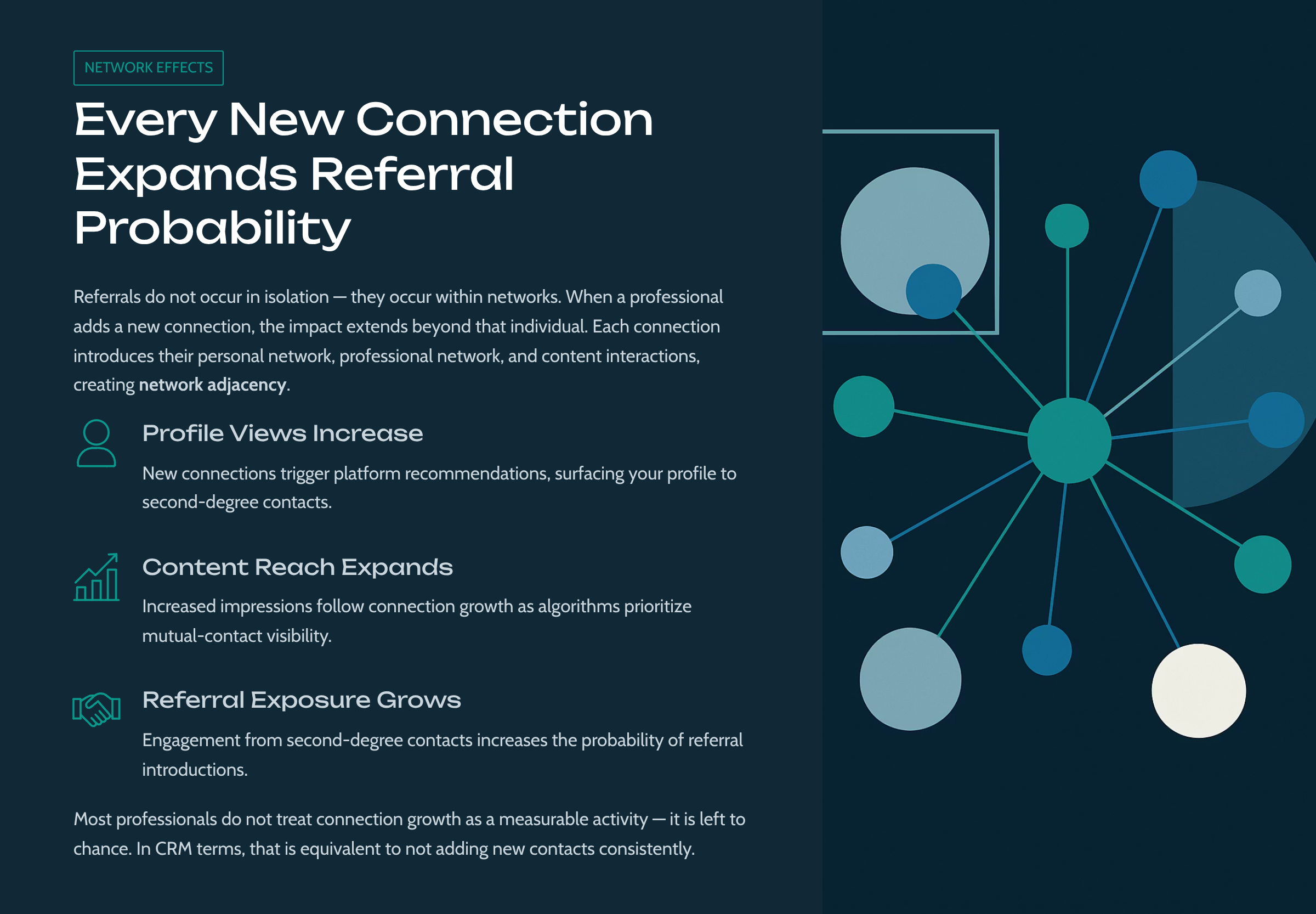
Network Expansion and Referral Probability
Referrals do not occur in isolation. They occur within networks.
When a professional adds a new connection, the impact is not limited to that individual. The connection introduces:
Their personal network
Their professional network
Their content interactions
This creates network adjacency.
Platform algorithms use this adjacency to recommend profiles, surface content, and prioritize visibility.
This is why new connections often lead to:
Increased profile views
New follower recommendations
Expanded content reach
The effect is not theoretical. It is observable through:
Suggested connections based on mutual contacts
Increased impressions after connection growth
Engagement from second-degree contacts
Each new connection increases the probability of referral exposure.
In a CRM context, this would be equivalent to not adding new contacts consistently.
The Behavior Gap
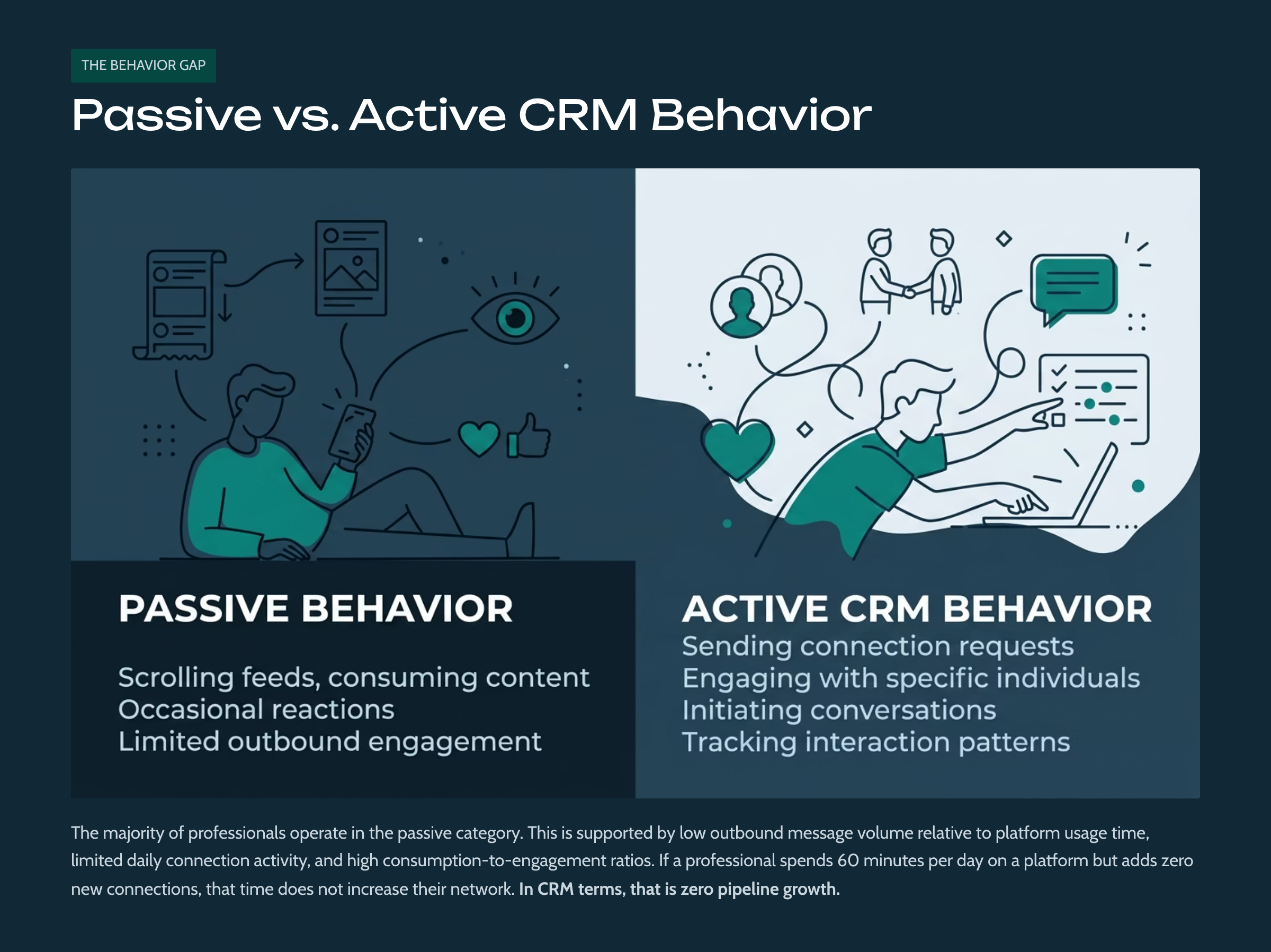
There are two dominant behaviors observed in platform usage:
Passive Behavior
Scrolling feeds
Consuming content
Occasional reactions
Limited outbound engagement
Active CRM Behavior
Sending connection requests
Engaging with specific individuals
Initiating conversations
Tracking interaction patterns
The majority of professionals operate in the first category.
This is supported by:
Low outbound message volume relative to platform usage time
Limited daily connection activity
High consumption-to-engagement ratios
The gap between passive and active behavior represents missed relationship capture.
If a professional spends 60 minutes per day on a platform but adds zero new connections, that time does not increase their network.
In CRM terms, that is zero pipeline growth.
Why Content Alone Is Insufficient
Content plays a role in visibility and credibility. It does not replace relationship building.
Data from platform analytics shows:
Content reach is heavily influenced by prior engagement
Posts are more likely to be shown to people with existing interaction history
New audiences are often reached through shared connections rather than direct discovery
This means content performance is tied to network quality.
Without consistent connection growth and engagement, content distribution plateaus.
This is why two professionals with similar content can experience different outcomes:
One has an actively expanding network
The other relies on static connections
The difference is not content quality. It is network behavior.
Observable Patterns in High-Performing Profiles
Profiles that generate consistent inbound opportunities show similar patterns:
Frequent connection activity
Targeted engagement with specific individuals
Consistent messaging follow-up
Visible interaction across multiple networks
These behaviors can be verified through:
Connection growth metrics
Engagement distribution across posts
Message volume and response rates
High-performing profiles do not rely solely on posting schedules. They operate as active relationship systems.
The Operational Shift
To use social media as a CRM, the focus must shift from content output to relationship input.
This does not require new tools. It requires a change in daily activity.
Core actions include:
Connection Identification
Reviewing suggested connections
Identifying local professionals and homeowners
Prioritizing relevance over volume
Connection Execution
Sending requests with context when appropriate
Maintaining a consistent daily target
Engagement Tracking
Noting repeat interactions
Responding to comments and messages promptly
Observing behavioral signals
Conversation Initiation
Starting direct messages based on visible activity
Referencing shared context or recent interactions
Each of these actions aligns with CRM functions:
Adding contacts
Logging interactions
Initiating follow-up
The difference is that the platform already provides the data.
Measurement and Accountability
A CRM system requires measurement. Social media should be treated the same way.
Key metrics include:
New connections per week
Outbound messages initiated
Response rate to messages
Engagement from first-degree connections
Engagement from second-degree connections
These metrics are observable through platform analytics and activity logs.
Without measurement, activity defaults to passive behavior.
With measurement, activity becomes intentional.

Risk of Inaction
If social platforms continue to prioritize relationship-based visibility, professionals who do not adapt will experience:
Reduced content reach
Limited network growth
Decreased referral exposure
This is not a future prediction. It is already visible in:
Declining organic reach for low-engagement profiles
Increased importance of mutual connections in feed visibility
Higher engagement concentration among active network builders
The cost of inaction is not immediate loss of business. It is gradual reduction in visibility within referral networks.
What This Unlocks
When social media is treated as a CRM:
Network size increases consistently
Interaction frequency rises
Visibility improves across connected networks
Referral probability expands
These outcomes are not dependent on platform changes. They are driven by behavior within existing systems.
The professional gains:
Greater control over relationship growth
Increased exposure to second-degree networks
More consistent inbound conversations
Conclusion
Social media already contains the structure of a CRM system. It stores contacts, tracks interactions, and expands networks.
Most professionals do not use it that way.
They focus on content distribution instead of relationship acquisition. They measure impressions instead of connections. They rely on inbound activity instead of initiating engagement.
The result is a gap between effort and outcome.
The signal is clear:
If social media is where relationships are visible, then it must be treated as the system where relationships are built and managed.
This is not an additional strategy. It is a reclassification of an existing system.
Professionals who adopt this view will align their daily activity with how platforms actually operate.
Those who do not will continue to invest time without proportional network growth.
The platform has already shifted.
The question is whether behavior will follow.