

Top of the SERP: The Pay-Per-Lead Blueprint
Top of the SERP: The Pay-Per-Lead Blueprint
How can real estate agents optimize Google Local Services Ads to out-rank competitors, lower Client Acquisition Costs (CAC), and capture high-intent property listings at scale?
Google Local Services Ads (LSAs) represent a critical paradigm shift in digital lead generation for real estate. Unlike traditional, keyword-based Google Ads (Pay-Per-Click), LSAs operate on a Pay-Per-Lead (PPL) model.
For a real estate agent coaching top-producing agents, understanding the mechanics, economics, and optimization of LSAs is essential for capturing high-intent consumer traffic at the absolute top of the search engine results page (SERP).
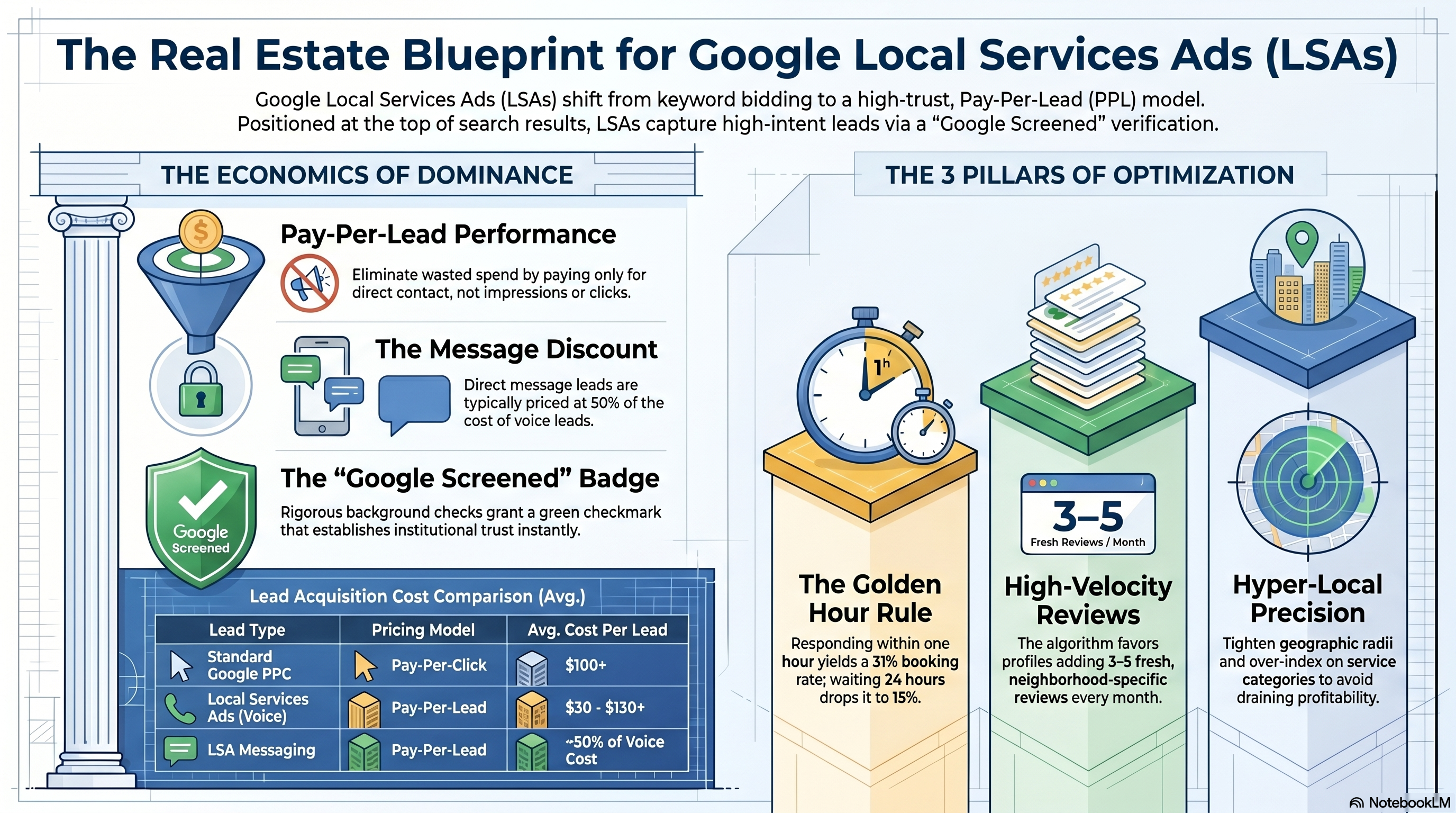
1. The Context: Shifting from Search to Answers
LSAs occupy the single most valuable piece of digital real estate on Google. They appear at the absolute top of mobile and desktop search results, positioned directly above traditional sponsored text ads, above the Google Maps "Local 3-Pack," and far above organic SEO listings.
The "Google Screened" Badge
To run LSAs, real estate professionals must pass a rigorous background check, license verification, and insurance screening. Once approved, the ad features a prominent green checkmark labeled "Google Screened." This badge instantly establishes institutional trust and credibility before a consumer even interacts with your profile.
The Dawn of Nuanced Intent
Traditional Search Engine Optimization (SEO) relied heavily on broad keyword terms like "Rancho Cucamonga Real Estate Agent." Modern consumers utilize deep, conversational intent: "Find me a highly rated agent available this weekend who has verifiable experience navigating complex probate listings in the Inland Empire."
LSAs are perfectly built for this transition. The engine scans its local data ecosystem to verify your licensing, your specific neighborhood boundaries, and your active consumer reviews to present the safest, most logical professional entity to the user.
2. The Economics: Lowering Client Acquisition Cost (CAC)
The defining advantage of LSAs is the structural elimination of wasted ad spend on accidental, curious, or low-intent clicks.
Pay-Per-Lead Only: You pay nothing for impressions, views, or clicks. You are only charged when a consumer takes a direct, trackable action to contact you—such as a phone call lasting longer than a specific duration, a direct text message, or a booked appointment.
Cost Per Lead (CPL) Benchmarks: While standard Google Pay-Per-Click (PPC) real estate leads frequently average $100+ per lead due to heavy platform auction competition, LSA high-intent leads typically range from $30 to $130+ per lead. Pricing is heavily dependent on market density and local competition (e.g., major metros like Phoenix, Dallas, or Los Angeles sit at the higher end of the spectrum).
The Message Discount: Google heavily rewards consumer messaging over voice lines. Direct message leads processed through the LSA platform are typically priced at 50% of the cost of a direct voice/phone lead.
Automated Budgeting: Instead of a rigid daily cap, you establish a weekly target budget. Google adjusts ad delivery based on real-time search volume fluctuations, pausing your placement once your weekly threshold is achieved.
3. High-Impact Tactical Use Cases
For Real Estate Agents: Hyper-Local Dominance
Traditional lead generation channels often capture "top of funnel" lookers who require months of incubation. LSA users are actively looking for a professional to hire immediately. Agents can target hyper-specific zip codes or neighborhoods. When a user searches "best real estate agent near me," LSAs position the optimized agent as the immediate local authority.
4. Driving Maximum Impact: The Algorithm's Core Signals
Simply launching an LSA profile is not enough to win the top positions. Because Google only monetizes these ad spaces when a valid lead is generated, the algorithm aggressively rewards profiles that actively convert. To secure a permanent spot in the top visible positions, you must optimize across three operational pillars:
Pillar I: Response Time & Lead Management
The LSA algorithm tracks your operational responsiveness with precision.
The Golden Hour Rule: Responding to an LSA inquiry within one hour yields an average booking rate of 31%. Waiting more than 24 hours drops that conversion rate to 15% and penalizes your ad ranking.
System Integration: Real estate teams must route LSA phone numbers directly to a live Inside Sales Assistant (ISA), an un-interrupted primary line, or sync it directly to an automated CRM workflow (like Follow Up Boss) to ensure zero missed opportunities. Missed calls are the most expensive leaks in an agent's P&L.
Pillar II: Review Velocity and Semantic Depth
While your physical office coordinates matter for proximity matching, review velocity (how many reviews you consistently receive) and overall rating carry massive algorithmic weight. The system heavily favors an active profile adding 3–5 new reviews a month over a stagnant profile with a high historical count but zero recent activity.
Furthermore, generic feedback like "They were great!" provides weak search signals. Train your clients to leave Semantic Reviews by asking them:
"Could you leave a quick review explicitly mentioning the specific neighborhood we worked in (e.g., Shady Canyon), the property type, and the exact transaction problem we successfully solved?"
Pillar III: Aggressive Profile Optimization
Over-Indexing on Categories: Ensure every single specific service sub-category you handle (e.g., residential sales, luxury properties, relocation, property management) is checked during setup. Leaving categories blank means completely missing out on filtered consumer searches.
Service Area Tightening: Start with a tight, hyper-targeted radius around your primary target markets. If your service area is drawn too wide, you risk paying for high-cost leads in geographic areas you cannot efficiently service, directly draining your profitability.