
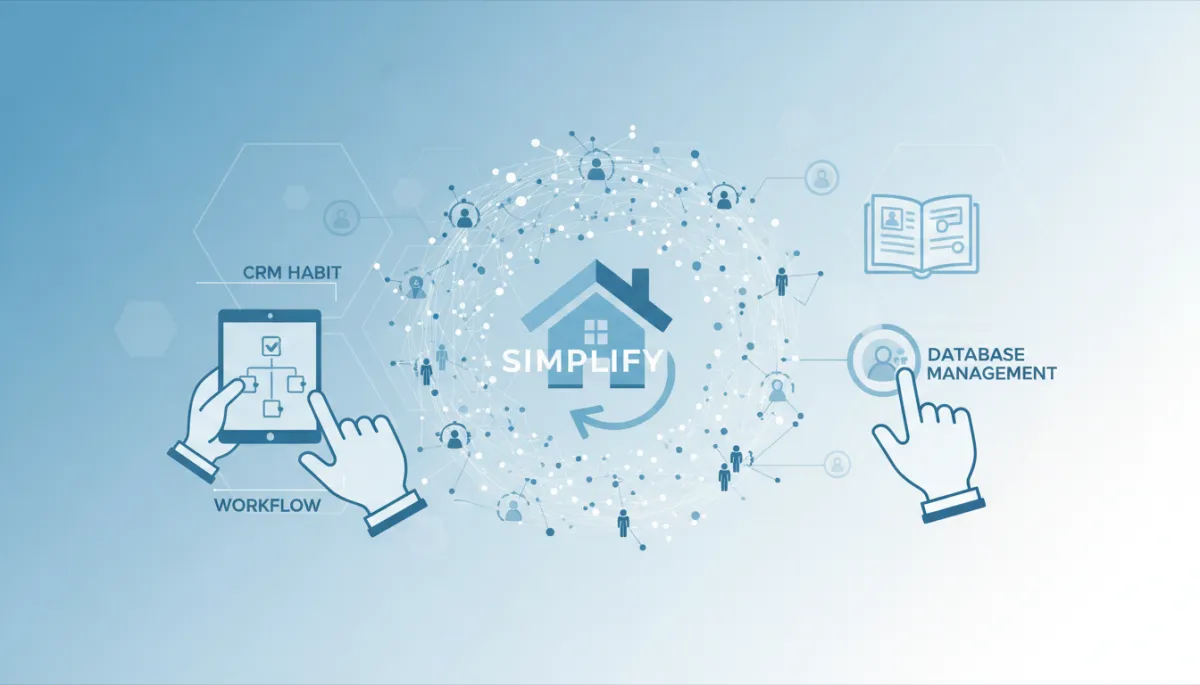
Transform Your Real Estate CRM Habits
Real Estate, CRM, Workflow, Database Management
One CRM Habit That Changes Everything for Real Estate Agents
Discover the single Customer Relationship Management habit that can simplify your workflow, strengthen your database, and create more predictable income as a real estate professional.
The One CRM Habit: Daily, Non‑Negotiable Database Power Hour
Among all the tools, tactics, and trends marketed to real estate agents, one simple CRM habit consistently separates agents with predictable pipelines from those who live deal to deal: a daily, non‑negotiable database power hour. This is a focused 60‑minute block where you work exclusively inside your CRM on Customer Relationship Management activities — not social media, not paperwork, not browsing listings — just your database and the relationships inside it.
At its core, this habit is about one idea: simplify. Instead of trying to manage leads in your inbox, texts, spreadsheets, and sticky notes, you commit to a single system of record and a consistent, repeatable workflow. When you treat your CRM like the engine of your business and give it disciplined attention every day, your database management transforms from chaotic to strategic.
Why This CRM Habit Matters More Than Any New Tool
Many real estate agents believe that the right CRM tools will fix their follow‑up problems. In reality, the software you choose is far less important than the consistency with which you use it. A sophisticated Customer Relationship Management platform with no data, no notes, and no tasks is less valuable than a simple system that you update daily and trust completely.
The daily database power hour does three critical things for your business:
It centralizes your information, so every lead, past client, and sphere contact lives in one organized database.
It creates a predictable workflow for outreach, follow‑up, and nurturing, instead of reactive, last‑minute scrambling.
It builds a long‑term asset: a living, breathing CRM that grows in value with every note, tag, and interaction you log.
📌 Key Takeaway: The game‑changer is not a new app; it is the discipline of showing up in your CRM every single workday.
How to Structure Your Daily Database Power Hour
To make this CRM habit sustainable, you need a clear structure. Think of your power hour as a simple, repeatable routine rather than an open‑ended task. Here is a practical framework tailored to real estate agents that balances database management with proactive outreach:
10 minutes – Clean and update your database. Merge duplicates, correct contact details, add missing emails or phone numbers, and assign tags or categories (past client, hot buyer, investor, neighborhood farm, etc.). This keeps your Customer Relationship Management system accurate and usable.
20 minutes – Log yesterday’s conversations. Add notes from calls, showings, open houses, and sign‑ups. Record motivations, timelines, objections, and personal details. Your future self will rely on this context when you follow up weeks or months later.
20 minutes – Execute today’s follow‑up tasks. Work from your CRM task list only. Call, text, or email the people scheduled for today, then mark tasks complete, reschedule when appropriate, and note outcomes. This is where your workflow turns into real conversations and appointments.
10 minutes – Plan tomorrow’s outreach. Create new tasks for prospects who need follow‑up, schedule check‑ins with past clients, and set reminders for key dates such as lease expirations or home purchase anniversaries. You finish each session with a clear plan for the next one.

A structured daily power hour turns a static contact list into a living, revenue‑producing database.
Simplify Your Tools to Strengthen Your CRM Workflow
Many agents unintentionally complicate their businesses by scattering contact information across multiple tools: email platforms, lead portals, spreadsheets, personal phones, and social media inboxes. The more places your data lives, the harder it is to manage, and the easier it is for valuable relationships to slip through the cracks.
The daily power hour is your opportunity to simplify. Instead of letting data stay fragmented, you intentionally pull everything into your central CRM:
Add new leads from portals and open houses into your main database.
Import or manually enter contacts from spreadsheets and email lists so they become part of your Customer Relationship Management system.
Log social media conversations and direct messages as notes, then create tasks for structured follow‑up.
💡 Pro Tip: If a contact is not in your CRM, it effectively does not exist in your business. Make “no orphan contacts” a guiding rule for your database management.
Turning Your Database into a True Business Asset
For many real estate agents, a database is little more than a long list of names. The daily CRM habit transforms that list into a strategic asset. Each time you update a record, add a note, or schedule a task, you are increasing the value of your business — not just for today’s deals, but for the next three, five, or ten years.
Over time, consistent database management allows you to:
Identify patterns in your pipeline — such as which lead sources convert best and which neighborhoods produce repeat business.
Segment contacts into meaningful groups for targeted marketing: first‑time buyers, move‑up sellers, investors, or past clients who refer often.
Create automated nurture campaigns that work alongside your daily power hour, so your Customer Relationship Management system is always working in the background.
Overcoming Common Objections from Real Estate Agents
Even experienced real estate agents often resist this habit at first. The most common objections usually sound like this:
“I am too busy with showings and appointments.”
“I am not a tech person; CRMs feel complicated.”
“My business is built on referrals; I do not need a formal system.”
The reality is that a well‑maintained CRM supports all of these priorities. When you simplify your tools and commit to a daily power hour, you spend less time hunting for information and more time in meaningful conversations. Technology becomes a quiet assistant, not a distraction. And a referral‑based business becomes even stronger when your workflow ensures that no past client is ever forgotten.
📌 Key Takeaway: You do not need to master every feature of your CRM. You only need to master one habit — showing up daily and working your database with intention.
Implementing the Habit: Practical Steps for the Next 30 Days
To turn this concept into a lasting CRM habit, treat the next 30 days as a focused implementation period. Here is a simple plan you can adopt immediately:
Choose your time block. Ideally, schedule your database power hour early in the day, before fires and distractions appear. Add it to your calendar as a recurring appointment and protect it like a listing presentation.
Define your non‑negotiables. Decide what must happen in every session: cleaning data, logging conversations, executing tasks, and planning tomorrow. Keep the routine consistent so it becomes automatic.
Limit competing tools. Commit to your primary CRM as the hub of your database management. If another platform captures leads, your job during the power hour is to move them into your central system.
Track one simple metric. For the first month, measure how many meaningful contacts you make each day through your CRM workflow. This keeps you focused on relationships, not just data entry.
Conclusion: Build a Business That Compounds Over Time
As a real estate professional, your most valuable asset is not your latest listing, your branding, or even your market knowledge. It is the strength of your relationships and the reliability of your Customer Relationship Management system. The one CRM habit that changes everything — a daily, non‑negotiable database power hour — is the bridge between scattered contacts and a truly scalable business.
When you simplify your tools, commit to a consistent workflow, and treat your database as a living asset, your CRM stops being “just software” and becomes the quiet partner that supports every closing and every referral. Over months and years, this discipline compounds into a larger, warmer, and more responsive sphere — one that generates business even when the market shifts.
The invitation is straightforward: for the next 30 days, honor a single hour each workday dedicated entirely to your CRM and database management. As you do, you will likely find that the habit itself — not the latest feature, script, or trend — is what truly changes everything in your real estate business.