
Boost Real Estate Visibility with AI Search
Real Estate Marketing, AI Search, Agent Websites
Your Website Isn't Failing SEO. It's Failing AI Search.
37% of consumers now use AI (ChatGPT, Perplexity, Gemini) to find agents instead of Google. 91% of agents don't show up when they do. If that makes your stomach flip a little, you’re not alone. For years, you’ve been told to “get on page one of Google” and “keep posting to your blog.” You invested in SEO, maybe paid for a fancy IDX site, and watched your rankings slowly climb. On paper, everything looks fine.
But when today’s buyers open an AI tool and type, “Who is the best buyers’ agent in Scottsdale for first-time buyers?” you’re nowhere to be found. Not in the answer. Not in the citations. Not even in the sources list. The problem usually isn’t that your SEO “stopped working.” It’s that AI search is playing a different game entirely—and most agent websites were never built for it. In this post, we’ll unpack what’s changed, what AI is actually looking for, and how you can start fixing your AI visibility without throwing away everything you’ve already done for SEO.
SEO vs. AEO: Page One vs. Being in the Answer
Let’s start with the core shift: SEO gets you on page one. AEO gets you cited in the answer. SEO (search engine optimization) is about convincing Google to rank your page when someone types “homes for sale in Denver” or “best realtor near me.” You optimize keywords, meta descriptions, backlinks, and page speed so your site shows up in the list of blue links or map pack. That still matters.
AEO—Answer Engine Optimization—is different. When someone asks an AI tool, “Which neighborhoods in Austin are best for young families?” the user doesn’t want 10 links. They want a direct, conversational answer. The AI scans the web, pulls information from multiple sources, and weaves it into one response. Only a handful of sites get cited underneath as “Sources.” Those sources are where the trust and the clicks go.
In other words:
SEO win: You appear on page one of Google results.
AEO win: Your name, website, or Google Business Profile is cited directly under the AI-generated answer.
Both are valuable, but as more buyers start in AI search, citations are quickly becoming the new “page one.” According to recent benchmarks, only about 8.4% of U.S. agents show up in AI-generated responses in their market, while the top 1% of agents capture nearly half of all citations. That’s a winner-takes-most environment—and it’s exactly why AEO matters.
What’s Changed in AI Search (and Why Real Estate Is Behind)
In 2026, AI search stopped being a novelty. It became the front door. Industry data shows 61.3% of buyer-side real estate searches now begin in AI search engines like ChatGPT, Perplexity, Gemini, Claude, and Google’s AI experiences—more than Google or Zillow alone. And 67% of home buyers say these AI tools are their primary research method before they ever contact an agent.
At the same time, Google has rolled out AI Overviews across more real estate queries. In many markets, these AI summaries appear across a huge portion of “how to” and “which neighborhood” searches—things like “best schools in Charlotte suburbs” or “how much are closing costs in Phoenix.” In some verticals, AI Overviews show up in the vast majority of searches; in real estate, they’re still emerging, but they’re already reshaping what buyers see first.
Buyers are also using standalone AI tools for deeper research:
Perplexity to compare neighborhoods, schools, commute times, and price trends in one answer.
ChatGPT or Gemini to ask, “Which agents specialize in VA buyers in Tampa?” or “Who is the top condo agent in downtown Seattle?”
Meanwhile, portals are already feeling the impact. Zillow’s agent-discovery traffic has dropped significantly, with a big portion of that attention flowing into AI tools instead. The bottom line: the shift isn’t coming—it’s here. If your visibility plan begins and ends with “rank my website and pay for portal leads,” you’re missing where buyers are actually starting their search in 2026.
How AI Actually Pulls Answers (and Why Your Site Gets Skipped)
AI tools don’t “read” the web the way humans do. They’re not scrolling your homepage, admiring your hero image, and thinking, “Wow, great branding.” They’re scanning for structured, credible, citable content they can safely stitch into an answer. When someone asks, “Who is the best listing agent in Plano for luxury homes?” the AI is looking for signals like:
Clear, question-based content (e.g., “Who is the best luxury listing agent in Plano?” in an FAQ or blog heading).
Structured data that labels you as a RealEstateAgent or LocalBusiness with reviews, areas served, and specialties.
Consistent NAP data (name, address, phone) across your website, Google Business Profile, and directories.
Review language that matches what buyers ask: “first-time buyer,” “relocation,” “VA loan,” “luxury condo,” “investment property,” and so on.
Most agent sites fall down on exactly these points. They have:
A generic homepage (“Top service. Local expertise.”) with no clear questions or answers.
No FAQ pages that mirror what buyers actually ask AI tools.
Little or no schema markup (the structured data that tells machines what your content means).
Reviews that say “great agent!” instead of “helped us buy our first home in Queen Anne under budget.”
When AI can’t easily extract who you are, what you do, and who you serve, it simply picks someone else. That’s how we end up with 91% of agents effectively invisible in AI answers, even while 82% of agents say they now use AI tools daily. They’re using AI, but their online presence isn’t built for AI to use them as a source.
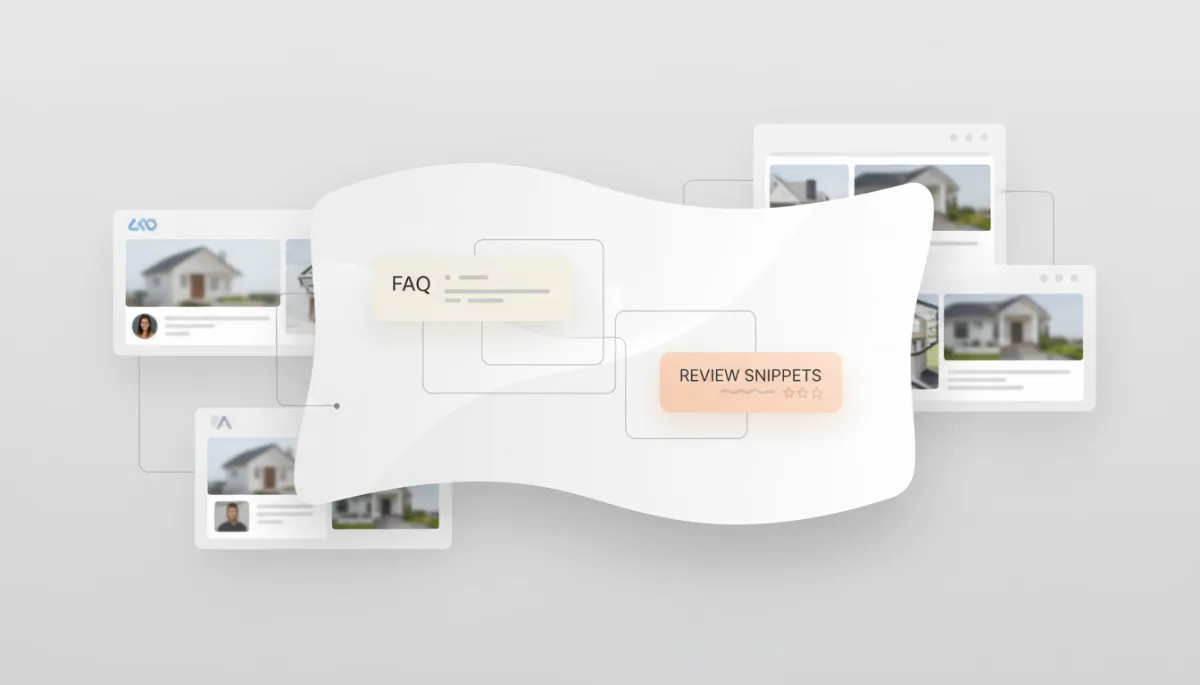
Agents with structured, question-based content are far more likely to be cited in AI answers.
What AEO Looks Like for a Real Estate Agent (In Plain English)
So what does Answer Engine Optimization actually look like for you, the working agent juggling showings, inspections, and contracts? You don’t need a computer science degree. You do need to make your online presence look like something an AI would feel confident quoting. That usually includes:
1. Structured FAQ Pages That Mirror Real Questions
Instead of only having “About,” “Listings,” and “Contact,” add FAQ pages by topic and location, such as:
“First-Time Homebuyer FAQ – Denver, CO”
“Moving to Raleigh from Out of State: Relocation FAQ”
“Selling a Luxury Home in Westlake: Common Questions Answered”
Use the exact questions buyers ask AI tools as your headings: “What are the safest neighborhoods in…?”, “How much are closing costs in…?”, “Who is the best agent for…?” Then answer in clear, straightforward language. This gives AI clean, ready-made snippets to quote—and a reason to list you as a source.
2. An Optimized Google Business Profile (GBP)
AI tools lean heavily on trusted, verified business data, and your Google Business Profile is one of the strongest signals. For AEO, you want your GBP to be:
Fully filled out with categories like “Real Estate Agent,” service areas, and specialties.
Loaded with recent, detailed reviews that mention location and situation (“helped us buy a condo in downtown Miami as first-time investors”).
Consistent with your website’s name, address, phone, and branding.
When AI cross-checks your site against your GBP and sees they match, your credibility score goes up—making you a safer choice to cite.
3. Reviews with Specific, Question-Matching Language
Generic praise doesn’t help AI much. But a review like, “Sarah helped us relocate from Boston to Austin, guided us through schools and neighborhoods, and negotiated our first home in Circle C under asking,” is gold. It contains:
A buyer type (relocation, first-time, investor, VA, downsizer).
A location (Circle C, Austin, specific neighborhood).
A result (under asking, fast sale, multiple offers).
Those details map directly to the kinds of questions people ask AI, which makes your profile a natural fit to appear in answers like, “Who is the best relocation agent in Austin for families?”
4. Consistent NAP Data Everywhere
It sounds boring, but consistency is a trust signal. If your website footer says “The Smith Group,” your GBP says “Smith Real Estate Team,” and your Facebook page says “Smith Realty,” AI has to work harder to be sure you’re the same business. Any friction lowers confidence and makes you less likely to be cited. Align your:
Business name (exact spelling and wording).
Address (suite numbers, abbreviations like “St.” vs. “Street”).
Phone number (format and digits).
5. Content That Directly Answers Buyer and Seller Questions
The agents winning AI visibility aren’t just posting “Market Updates – May 2026.” They’re publishing content that lines up with real, conversational questions, such as:
“Is now a good time to buy a condo in downtown Chicago?”
“What are the safest neighborhoods in Jacksonville for young families?”
“How much do I need to buy a home in Phoenix with a VA loan?”
They use those questions as titles and headings, then answer clearly, with local details, numbers, and examples. That’s the kind of content AI can quote confidently—and the kind that gets your name in front of buyers before they ever hit a portal.
💡 Friendly tip: If you’ve ever thought, “Clients keep asking me the same questions,” that’s your AEO to-do list. Turn each of those questions into a dedicated FAQ entry or blog post.
A Short, Practical Starting List for Agents (You Can Do This in a Week)
If this all feels big, let’s shrink it down. You don’t need to rebuild your website from scratch. Start with these five steps to make your existing presence more AI-friendly:
Audit your Google Business Profile. Log in and make sure every field is complete. Add your service areas, specialties (first-time buyers, luxury, relocation, investors), and a clear description that mirrors what your ideal clients would type into AI tools. Upload recent photos and verify your hours and contact info.
Add at least one focused FAQ page. Choose your main niche—maybe “First-Time Buyers in Charlotte” or “Relocating to Boise”—and create a simple FAQ page with 8–12 real questions and short, honest answers. Use the exact wording your clients use in emails and texts.
Check and fix NAP consistency. Make a quick list of your website, GBP, Facebook page, Instagram profile, Zillow, Realtor.com, and any local directories. Confirm that your name, address, and phone number match exactly across all of them. Update anything that’s off, even if it’s just a small spelling or formatting difference.
Request three new, detailed reviews. Reach out to a few recent clients and ask them (kindly) to mention specifics: the city or neighborhood, what you helped them do (buy, sell, relocate, invest), and what made the experience stand out. You can even give them a short prompt to make it easier: “It helps a lot if you mention the neighborhood and what I helped you with.”
Improve two existing blog posts. Pick two posts that already get some traffic. Add a clear question at the top (“Is now a good time to sell in [Your City]?”), tighten the answer, and include a short bullet list with local facts or stats. Think: “Would this be easy for an AI to quote in two sentences?”
📌 Key takeaway: You don’t need to become a tech expert. You just need to make your expertise easy for AI tools to recognize, trust, and reuse.
SEO Is Still Working. AI Search Is Something Else Entirely.
Here’s the reassuring part: if you’ve invested in SEO, that work isn’t wasted. Good SEO—fast site, useful content, clear navigation—still helps you. It’s just not the whole story anymore. AI search is a parallel layer on top of traditional search, with its own rules. You can rank on page one and still be invisible in AI answers. Or you can be a smaller, nimble agent who never dominated Google, but shows up again and again in AI citations because your content is structured and specific.
As AI continues to shape how buyers research neighborhoods, compare agents, and decide who to call, the gap between “visible” and “invisible” will only grow. The agents who adapt now—by adding FAQ content, tightening up their GBP, and making their expertise easy to quote—are setting themselves up to own that new front door.
Ready to Be Visible in AI Search? Here’s Your Next Step.
If you’ve read this far, you’re already ahead of most agents. You understand that your website isn’t “broken”—it’s just not speaking the language AI tools listen for. The good news is that you can start changing that this week, with small, practical steps that fit into a busy real estate schedule.
Begin with the five-item checklist above. Even a single, well-built FAQ page and a cleaned-up Google Business Profile can make a noticeable difference over the next few months. And if you’d like help, you don’t have to figure it out alone.
If you’re curious where you stand today—or you’re ready to stop being invisible in AI search—reach out for a quick, no-pressure audit. We’ll look at how often you’re being cited now, identify the easiest wins, and map out a simple plan to turn your website into something AI actually wants to recommend. Your future clients are already asking AI for help. Let’s make sure it knows your name.