
Finding Your Next Listing with Ai
Real Estate, AI, Geographic Farming
The End of “Blind Farming”: How AI-Driven Propensity Scoring is Changing the Listing Game
Geographic farming is no longer about blanketing an entire neighborhood and hoping something sticks. With AI-driven propensity scoring, real estate agents can finally turn “blind farming” into precise, profitable targeting that focuses on the homeowners most likely to list next.
From Traditional Farming to Targeted, AI-Driven Farming
Traditional geographic farming has always been about consistency: pick a neighborhood, mail every door, knock every street, repeat for years. It works—eventually—but it demands huge time and money because you treat every homeowner as equally likely to move. In reality, some doors are far closer to listing than others.
AI-driven propensity scoring changes that equation. Instead of blanketing a ZIP code, you use data—time in home, equity, life-stage indicators, local turnover, online behavior, and more—to estimate how likely each address is to sell in the next 6–12 months. Geographic farming evolves into targeted farming, where you still “own” a farm, but your effort is concentrated on the highest-probability homeowners first.
The Problem with the Old “Shotgun” Approach
The classic shotgun approach—same postcard, same frequency, same message to everyone—has three big flaws:
Wasted budget: You spend heavily on owners who have almost zero intent to move in the foreseeable future.
Generic messaging: One-size-fits-all mailers and ads rarely feel relevant, so they get tossed or ignored.
Slow results: Because you are not prioritizing likely sellers, it can take years before your farm produces consistent listings.
In a market where inventory is tight and competition is fierce, “spray and pray” is simply too slow and too expensive. Agents who keep farming blindly will watch sharper competitors quietly cherry-pick the best opportunities.
The AI Solution: Prompt-Driven Segmentation into High, Nurture, and Monitor Tiers
AI doesn’t replace your farming strategy—it refines it. Using simple prompts, you can feed an AI tool your homeowner list (with basic attributes like years owned, estimated equity, property type, and recent activity) and ask it to:
Assign each address a propensity score to sell in the next 6–12 months.
Segment the list into three clear tiers: High, Nurture, and Monitor.
For example, a prompt might be: “Review this homeowner list and rank each household as High (likely to sell in 6–12 months), Nurture (12–24 months), or Monitor (longer term). Explain the patterns you see in each group.” In minutes, you have a prioritized farm instead of a flat list of addresses.
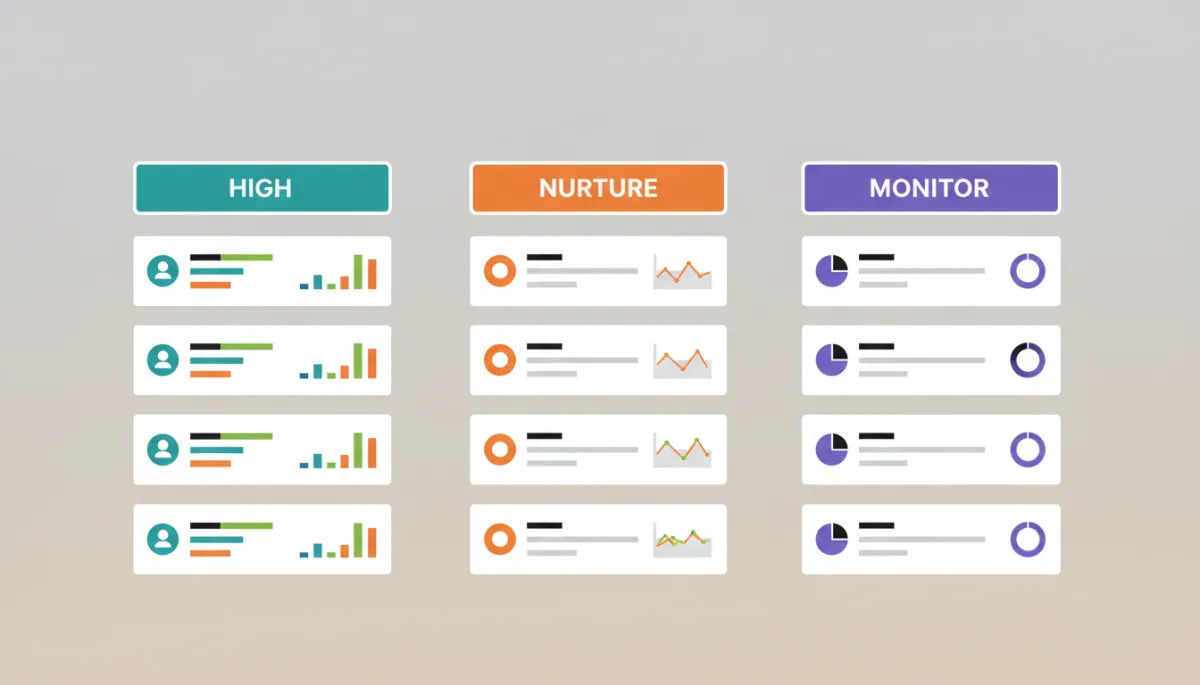
Tiered propensity lists turn a flat farm into a clear action plan.
Meet Sarah: An Agent Who Farms with Data, Not Guesswork
Consider Sarah, a listing-focused agent who used to mail the same postcard to 2,000 homes every month. Her results were decent, but her costs were climbing. She decided to plug her farm into an AI workflow and have the system score each address and segment it into High, Nurture, and Monitor tiers.
Now Sarah can see which 250–300 homes sit in the High tier. These are her most likely near-term sellers—owners with strong equity, longer tenure, recent life events, or behavior that suggests they are exploring a move. The Nurture tier contains households that show early signals but are probably 12–24 months out, while Monitor is everyone else she wants to stay visible with over time.
Hyper-Targeted Mail, Digital Ads, and Messaging for Each Tier
With her tiers defined, Sarah asks AI for specific campaigns for each group. Instead of one generic postcard, she now runs coordinated, hyper-targeted outreach:
High tier: Premium, personalized direct mail with recent neighborhood sales, estimated net proceeds, and a clear “Let’s talk timing” call to action. She mirrors this with retargeted digital ads that highlight fast sale timelines and strong prices for similar homes.
Nurture tier: Educational mailers and email sequences about market trends, renovation ROI, and move-up strategies. Her messaging here is softer: “When you’re ready, here’s how to plan your next move.”
Monitor tier: Light-touch neighborhood updates, community events, and branded awareness pieces so they steadily associate Sarah with local expertise, even if they are years away from selling.
Every tier hears from Sarah, but the frequency, channels, and message match their likelihood to move. Her budget goes where it has the highest odds of producing listings, not just impressions.
Speed, Scalability, and a Real Competitive Edge
This AI workflow gives Sarah three advantages that traditional farming can’t match:
Speed: Instead of spending weeks manually analyzing her farm, she can refresh propensity scores and tier assignments in minutes, then immediately adjust her campaigns.
Scalability: Once her prompts and workflows are dialed in, she can expand from one farm to several, or even layer on investor and expired listings, without multiplying her workload.
Competitive edge: While other agents are still mailing everyone the same “Just Listed/Just Sold” cards, Sarah is already in meaningful conversations with the homeowners most likely to sign a listing agreement next.
Data Is the New Soil: Start Planting with Targeted Prompts
Farming has always been a long game, but the rules have changed. Data is the new soil your business grows in. The agents who learn to work that soil—using AI-driven propensity scoring and smart prompts—will harvest more listings from the same neighborhoods, with less waste and more predictability.
You do not need to become a data scientist to start. Begin with a simple step: feed your homeowner list into an AI tool and use targeted prompts to segment it into High, Nurture, and Monitor tiers. Then ask for tailored messaging ideas, mailer copy, and ad angles for each group. Refine, test, and repeat.
The era of blind farming is ending. Agents who embrace targeted prompts and AI-driven propensity scoring will win more listings, faster, from the farms they already work. The question isn’t whether this shift is coming—it’s whether you will be early enough to benefit from it in your market.