
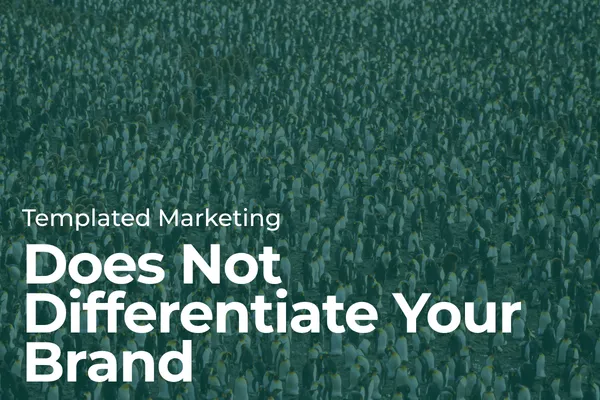
Avoid Templated Marketing: Stand Out with Unique Content
Content Marketing, Brand Differentiation, Templated Marketing
When Your Marketing Sounds Like Everyone Else’s: That’s Not an Accident
If your Content Marketing feels strangely familiar—like you’ve read it on five other sites this week—you probably have. That’s not a coincidence. It’s the business model. Templated Marketing is designed to scale content fast, not to protect your Brand Differentiation. The result is a flood of posts that are technically fine, but forgettable, interchangeable, and easy to ignore.
In a crowded market, Unique Content isn’t a nice-to-have; it’s the only way to stand out. Let’s walk through how templated approaches quietly flatten your voice—and what to do instead—so your Content Strategy actually reflects who you are, not just what an agency can reuse.
How templated marketing works
Templated Marketing is built on repeatability. Agencies and platforms create reusable frameworks, outlines, and phrases they can plug into dozens—or hundreds—of client accounts. The promise to you is attractive: “We’ll publish consistently, on brand, without you lifting a finger.”
A standard set of blog topics based on your industry, not your point of view.
Pre-written intros, transitions, and conclusions that get lightly edited.
Generic calls-to-action that could sit on any competitor’s site tomorrow.
This is efficient for the provider: one core set of assets, sold many times. That’s why so many “done-for-you” Content Marketing offers are affordable. You’re not buying deep thinking about your brand; you’re buying access to a content machine. Again: that’s not a coincidence. It’s the business model.
Why it’s hard to spot
The tricky part is that templated content doesn’t usually look bad. It passes basic checks: there’s a headline, subheads, keywords like Content Strategy are in the right places, the grammar is fine. For a busy professional, that can feel “good enough,” especially when you’re relieved to have anything going out at all.
It’s also hard to notice from the inside because you see your logo, your colors, your product screenshots. Visually, it feels like you. But read the same article with the branding stripped away and ask yourself: Could this belong to three of my competitors with almost no edits? If the answer is yes, your Brand Differentiation is being diluted every time you publish.

When content is swappable between brands, your differentiation quietly disappears.
What to check
You don’t need a content audit spreadsheet to spot templated patterns. Take three to five recent pieces—blogs, emails, or landing pages—and run them through these quick checks:
Voice test: Do you hear a specific person or just “marketing speak”? Unique Content usually sounds like a human with a point of view, not a brochure.
Swap-the-logo test: Remove your company name and logo in your head. Would the piece still clearly be yours, or could it easily be any competent brand in your space?
Specifics test: Count concrete details—customer stories, numbers, examples from your process. The fewer specifics, the easier it is to reuse the same structure for multiple clients.
“Only we” test: Highlight any sentence that would be hard for a competitor to claim. If you struggle to find one, you’ve uncovered a Content Strategy gap.
💡 Friendly tip: Do this with a colleague who’s less close to the content. Fresh eyes spot sameness faster.
The fix isn’t more content
When performance is flat, the default reaction is often, “We need to publish more.” But if your current approach is templated, scaling it just gives you more of the same generic output. Volume doesn’t fix sameness; it amplifies it.
Instead, the fix is to re-center your Content Marketing around what is distinct and honest about your brand:
Capture real stories from sales calls, customer interviews, and internal Slack threads. These are raw material no template can replicate.
Let subject-matter experts speak in their own language. Light editing beats heavy sanding that removes personality.
Choose fewer pieces and make them sharper, more opinionated, and more specific to your way of solving problems.
You’ll likely ship a bit less at first, but what you do publish will work harder for Brand Differentiation and long-term trust. That’s the real leverage point in a sustainable Content Strategy.
Do the check this week
To keep this practical, set aside 30 minutes this week—calendar block and all—to evaluate your current marketing through this lens. You don’t need a rebrand or a quarter-long project. You just need a quiet half hour and three questions:
Where does our content sound exactly like everyone else?
What stories, opinions, or details are we not telling that only we have?
What’s one small change we can make in the next piece we publish?
Maybe that change is adding a short founder quote, weaving in a real customer example, or replacing a stock phrase with the way your team actually talks. Small, consistent moves away from Templated Marketing add up quickly. Within a few weeks, your content starts to feel less like “more noise” and more like a clear, recognizable voice in your market.
The bottom line: if your content feels generic, it’s probably doing exactly what it was designed to do. That’s not a coincidence. It’s the business model. Your job now is to choose a different one—one that treats your experience, stories, and perspective as the template, not an afterthought.