
4 AI Starts Without Overloading Your Workflow
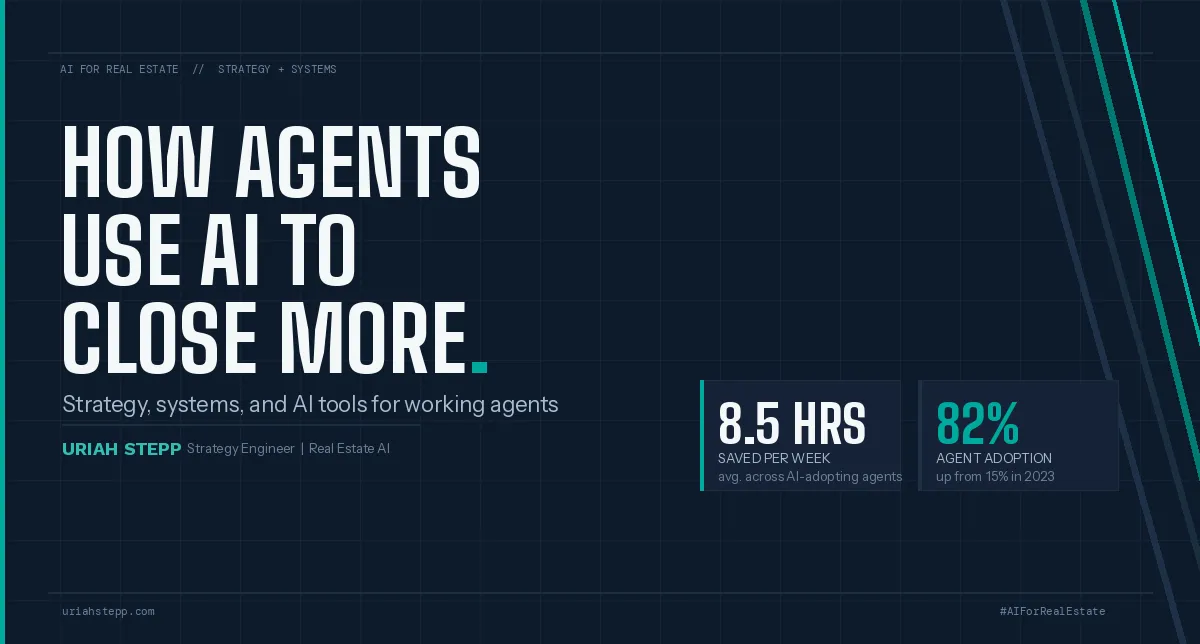
Agents using AI tools are getting back an average of 8.5 hours per week. That's a full workday returned to prospecting, showings, and client conversations.
AI adoption among agents crossed 82% in early 2026, up from just 15% in 2023. But only 17% report a significant impact on their business.
The gap isn't the technology. It's how agents are using it.
Why AI Adoption Hasn't Translated Into Results
Most agents who try AI start with the easiest win: writing. They use ChatGPT or Claude to draft a listing description or social caption, see the time savings, and stop there.
That's a reasonable entry point. But it treats AI like a faster typewriter instead of a system that touches lead response time, follow-up consistency, and client communication. Those are the parts of your pipeline that actually determine whether a lead becomes a closing.
The agents seeing real results are stacking two to four tools across different stages of their business. Each one handles a specific bottleneck. Not one general-purpose chatbot doing everything halfway.
The Real Cost of Slow Lead Response
A lead who fills out a form at 9 p.m. and doesn't hear back until the next afternoon has already contacted three other agents.
AI voice and texting tools respond within seconds, any time of day, and keep following up over weeks without you touching it. Some platforms maintain response rates in the 45 to 48% range over a 90-day follow-up window. That's well above what most agents manage with manual outreach.
Four Places to Start
1. Lead Response and Nurturing
Set up an AI texting or calling tool to handle the first response to every new lead, even when you're in a showing or asleep. The goal isn't to replace the relationship. It's to make sure no lead goes cold in the first hour, and that the long-shot leads still get a touchpoint six weeks later when you've moved on.
2. Listing Marketing and Video
Listings with video generate roughly four times more inquiries than photo-only listings. AI video tools can turn a folder of listing photos into a polished walkthrough in minutes with no videographer required. Use it on every listing, not just the premium ones. Consistency builds a reputation.
3. Market Analysis and Pricing Conversations
AI-driven valuation tools pull comparable sales, price trends, and absorption rates faster than a manual CMA. Use it as a starting point, then apply your local knowledge. The tool surfaces patterns in data. It doesn't know the house on the corner backs up to a busy road or that the renovation permit fell through last spring. That's your edge.
4. Daily Admin and Content
This is where most agents start, and it's worth doing right rather than quitting after two prompts. Draft listing descriptions, email sequences, open house follow-ups, and social captions with a writing assistant, then edit in your own voice. Keep a document of prompts that consistently work for your market and your tone. That's what turns a generic tool into something that actually sounds like you.
How to Add AI Without Overloading Your Workflow
Pick one bottleneck at a time.
If lead response is your weak spot, fix that before touching marketing tools. Adding three new platforms in the same month is how agents end up with subscriptions they never log into.
A sequence that works for most agents: lead response first, then listing marketing, then market analysis, then daily content. Each tool should remove something from your plate, not add a new dashboard to check.
Set a quarterly check-in with yourself. Which tools are you actually using? Which ones quietly stopped being worth the cost? The 82% adoption number includes a lot of agents paying for something they opened once. Don't be one of them.
The Bottom Line
AI won't replace the relationship-driven parts of this business. The trust you build at a kitchen table, the read you get on what a buyer actually wants, the judgment call on when to push back on price. Those stay yours.
What it does is protect your time so you can spend more of it on exactly those things instead of data entry, slow follow-up, and marketing tasks that used to eat your evenings.
Start with one tool, one bottleneck, this week. Give it thirty days before you judge it. The agents pulling ahead aren't using the most tools. They're using the right ones consistently.
What's costing you the most leads right now? Drop it in the comments.